
This Isn’t Yet a Negotiation
The U.S. and Iran proposals don’t overlap — despite Trump’s claims.

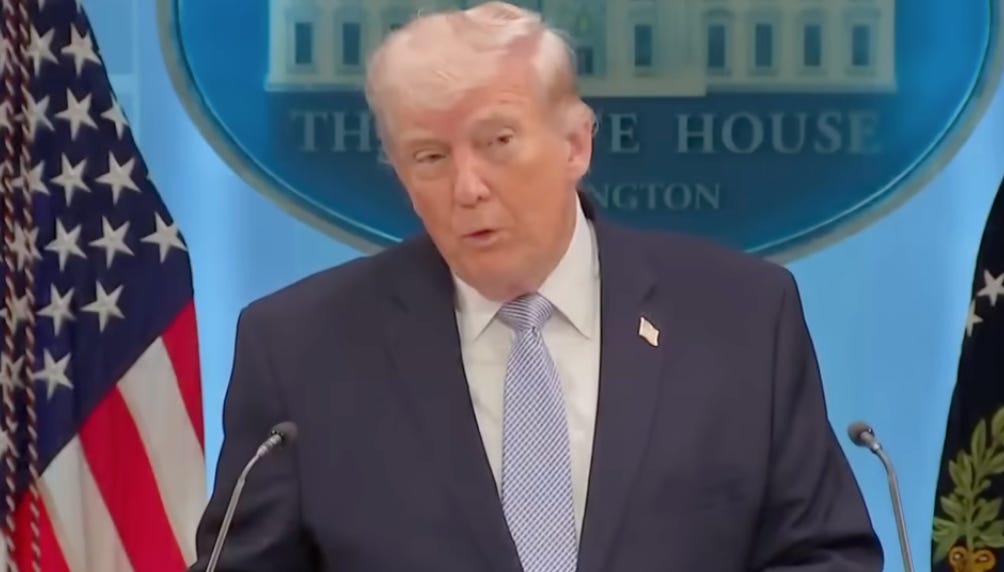
“We received a 10 point proposal from Iran, and believe it is a workable basis on which to negotiate.”
—Donald Trump, in a social media post, April 7, 6:32 PM
“Many of the 15 points have already been been agreed to.”
—Trump, in a social media post, April 8, 7:22 AM
The Trump administration has not released its so-called 15-point plan for ending hostilities with Iran, though Israeli media has published a version that seems fairly credible (though it doesn’t quite add up to 15 points). Yesterday, after Trump said Iran’s 10-point proposal was a “workable basis” for negotiations during a two-week ceasefire, the Islamic Republic publicly released it.
Both plans are below. I covered diplomacy for nearly a decade, and I don’t recall ever seeing such a mismatch in points for the start of a negotiation. Trump — who once demanded Iran’s “unconditional surrender” — claimed (with a typo) that “many of the 15 points have already been been agreed to.” The Iranian release suggests that’s absurd.
Iranian points
1. An American guarantee of nonaggression with Iran.
2. Iran maintains control of the Strait of Hormuz.
3. Ending the regional war on all fronts, including against Iran’s ally, Hezbollah, in Lebanon.
4. Withdrawal of U.S. combat forces from all bases and positions in the region.
5. Reparations to Iran for war damages.
6. Acceptance of Iran’s right to nuclear enrichment.
7. Lifting all primary sanctions on Iran.
8. Lifting all secondary sanctions on Iran.
9. Termination of all resolutions against Iran by the Board of Governors of the International Atomic Energy Agency (IAEA).
10. Termination of all United Nations Security Council resolutions against Iran.
United States points
1. Dismantling of existing nuclear capabilities that have already been accumulated.
2. A commitment that Iran will never seek to obtain nuclear weapons.
3. No uranium enrichment on Iranian soil.
4. All enriched material will be handed over to the IAEA on a near-term timetable to be defined between the parties.
5. Natanz, Isfahan, and Fordow will be taken out of operation — dismantled.
6. The International Atomic Energy Agency will have access to all information within Iran.
7. Iran will abandon the proxy paradigm (“axis of resistance”).
8. Iran will stop funding and arming regional proxies.
9. The Strait of Hormuz will remain open, a free maritime zone — no one will block it.
10. Missile program: the number and range will be limited and only for purposes of self-defense.
11. Lifting all sanctions.
12. The United States will assist Iran in promoting and developing a civil nuclear project in Bushehr (electricity generation).
13. The snapback sanction threat will be removed.
Analysis
Can two countries be further apart?
Iran, for instance, demands a right to uranium enrichment; the U.S. says there should be no enrichment on Iranian soil. That suggests another country might be able to enrich for Iran, but the right to enrich, even a low level, has always been a point of pride for Iran.
The U.S. also says nuclear facilities must be dismantled and all enriched material must be surrendered. Iran is silent on that, except for insisting uranium enrichmenmt will continue.
Meanwhile, the U.S. wants the Strait of Hormuz to remain an open maritime zone that no one — implicitly including Iran — can block. Iran demands it maintain control of the Strait. Threading the diplomatic needle could mean that Iran remains in control of the northern shore while traffic flows freely — but during this war Iran has learned it has leverage that is painful to the United States and the world economy. Tehran will not easily give up this leverage, and has indicated it seek to impose tolls.
Moreover, the United States wants Iran to stop funding regional proxies such as Hezbollah — while Iran demands that its allies stop coming under attack from Israel and the United States. Within hours of Trump announcing a ceasefire, Iran and the United States disagreed whether the truce included Lebanon, which came under heavy assault by Israel Wednesday.
In many cases, the two sides are talking past each other. Iran demands the withdrawal of U.S. combat forces from all regional bases; the U.S. plan never mentions that.
Similarly, the United States demands restrictions on Iranian missiles — which Iran has deemed non-negotiable. Barack Obama learned that when negotiating the Joint Comprehensive Plan of Action (JCPOA), which was silent on missiles. In a diplomatic sleight of hand, UN Security Council Resolution 2231, which endorsed the 2015 deal, called on Iran to refrain from activities related to nuclear-capable missiles for eight years (until 2023).
The U.S. seeks a commitment that Iran will never seek nuclear weapons. In theory, that’s easy for Iran — it has given it over and over. In fact, in Obama’s nuclear deal, Iran formally pledged that under no circumstances would it ever seek, develop, or acquire any nuclear weapons. So, now, Trump would think that was credible?
Iran insists on war reparations — politically impossible for Trump to deliver.
Ironically, both sides suggest they support an end to sanctions. But it’s difficult to see how they get there. The U.S. list focuses on elements that it considers a threat: Iranian enrichment; proxies; missiles. But Iran views that trio as existential — the deterrent that keeps the Iranian regime intact.
Either Trump is woefully uninformed or he’s whistling past the graveyard.
Trump even told one reporter that Iranian control of the Strait (specifically its charging ships a toll to pass through the Strait) was just fine, in fact, the US could join Iran in the toll collection shakedown and split the proceeds!
This is classic Trump. He’s unaware or doesn’t care, that this violates the UN Convention on the Law of the Sea, dating to the 1980s.