
Four Days Later, He Bombed Iran
Trump’s ‘talks’ were theater. The negotiators told the real story.
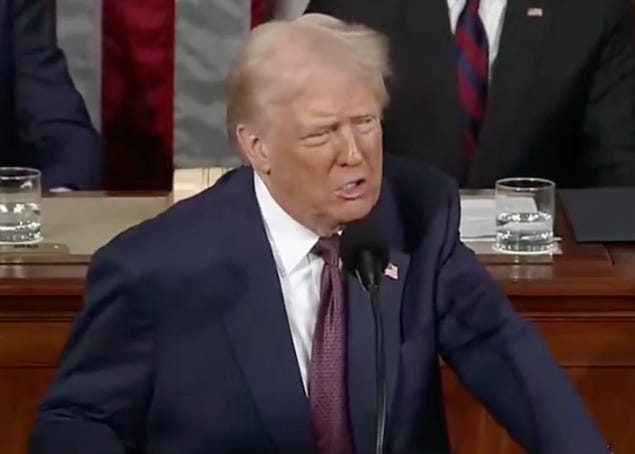
“They [Iran] want to make a deal, but we haven’t heard those secret words, ‘We will never have a nuclear weapon.’”
—Donald Trump, remarks during the State of the Union speech, Feb. 24
Just four days after saying these words in a major address to Congress, Trump announced he had ordered attacks across Iran and called for regime change. For Trump, words don’t matter much, but it’s another erosion of American credibility. A U.S. president shouldn’t start a war without a sustained effort to explain why it’s necessary. He’s an elected representative of the people, not a king.
Trump, in fact, only devoted two paragraphs to Iran in his State of the Union speech. By contrast, in George W. Bush’s State of the Union address in 2003 — delivered seven weeks before he ordered an invasion of Iraq — he used about 45 percent of the speech to make the case for war.
Instead, Trump pretended that he was engaged in negotiations with Iran. But that was just Kabuki theater. Trump was never serious about talks with Iran.
As evidence, just look at this line from Trump’s State of the Union address — that officials just need to declare that Iran won’t ever have a nuclear weapon. The Iranians say this all the time. They have, in fact, been saying this for decades. Whether one should believe them is another matter — and actions are more meaningful than words — but the very fact that Trump would say this in a speech shows that he and his advisers weren’t serious.
Indeed, one reason Barack Obama pursued a deal with Iran was that his team convinced themselves that the supreme leader, Ayatollah Ali Khamenei, had issued a fatwa against the development of nuclear weapons. A fatwa is a ruling by a religious authority, often with judicial implications. As Khamenei is the ultimate authority in Iran, his statements would seem to carry significant weight. Administration officials repeatedly cited the alleged fatwa as a reason to have confidence in Iranian intentions.
In 2013, as The Washington Post Fact Checker, I conducted a detailed inquiry into whether Khamenei had issued such a fatwa. The results were inconclusive. His statements had evolved over time and translations rendered the meaning differently. He may have referred to the use of nuclear weapons, as opposed to the development of them. But others disagreed, saying the evidence of the fatwa was solid. If that’s the case, you couldn’t get any statement stronger than a fatwa. Yet Trump pretends otherwise.
Not only that, when Iran signed the 2015 deal that Obama negotiated, it reaffirmed its commitment to the Nuclear Non-Proliferation Treaty and stated: “Iran reaffirms that under no circumstances will Iran ever seek, develop or acquire any nuclear weapons.” Yet here Trump is, 11 years later, claiming Iran has never said this.
There is another piece of evidence that shows Trump was never serious — personnel. Trump’s negotiators were Steve Witkoff, a real estate developer, and Jared Kushner, his son-in-law. Witkoff, with no previous experience in diplomacy, also handles negotiations concerning the Russia-Ukraine war. Trump isn’t serious about those talks either. He favors Russia in the war, so he allows intermittent talks to continue while Moscow pummels Ukrainian cities with missiles.
Obama’s nuclear deal, by contrast, was negotiated by his Secretary of State, John Kerry, with substantial assistance from Energy Secretary Ernest Moniz, an MIT nuclear physicist who handled the technical aspects of the agreement by working directly with Iranian counterparts (one of whom was an MIT graduate). These were serious people with expertise. Kerry not only had been the Democratic nominee for president but had chaired the Senate Foreign Relations Committee. Senior officials from China, France, Germany, the Russian Federation, the United Kingdom, and the European Union were also part of the talks.
As this was a negotiation, compromises were made. No diplomatic agreement is perfect, and some experts raised serious questions about what became known as the Joint Comprehensive Plan of Action (JCPOA) when it was completed in 2015. The highly technical text ran more than 150 pages, making it the longest arm-control agreement ever reached. (By contrast, the Agreed Framework that for some years halted the North Korea program was about four pages.)
When Trump took office the first time, he terminated the JCPOA in 2018. Let’s not pretend that this had much to do with policy; he just wanted to wreck any achievement by Obama. (He was less successful killing Obamacare, as that required passing a law.) He falsely claimed that the deal “leads to nuclear weapons for Iran in a short period of time.”
The JCPOA gradually lifted restrictions on the types of nuclear activities and the level of uranium enrichment Iran could conduct. These and other provisions sunset over 10, 15, 20, or 25 years. For instance, under the deal Iran could enrich uranium within narrow parameters — a ceiling of 3.67 percent and a stockpile cap of 300 kilograms through 2031 — with limits on centrifuges. If the deal had remained in place, some key provisions would expire in the next five years.

Supporters of the nuclear accord said the JCPOA bought time, subjecting Iran to constraints on its nuclear activities for a quarter century. By terminating the deal, Trump lifted those restrictions, permitting Iran to accelerate the program. He claimed he would negotiate a better deal, but took few steps to do so. When Trump was defeated in 2020, Joe Biden tried to revive the JCPOA — and found the Iranians were no longer interested.
Now that the Witkoff-led negotiations with Iran have been exposed as a farce, reporters should be much more skeptical of Witkoff’s talks with Russia. Too often, those talks are treated as real. Trump wants to reward Russian leader Vladimir Putin, whose photo he has hung in the White House. So he pays lip service to wanting peace — as he did in the State of the Union — while cutting off American aid to Ukraine. His goal is not to end the war, but to give Russia some sort of victory — including Ukrainian territory — that would allow for business deals with his cronies. If more Ukrainians die in the process, that doesn’t matter to Trump. No one should have any illusions that he does.
Laura Rozen’s reporting confirms that Trump’s nuclear negotiations with Iran were at best incompetent and likely more theatrical than serious. https://diplomatic.substack.com/p/no-imminent-threat-experts-dispute
Many, many times I heard Trump say the JCPOA, the Iranian deal that the Obama administration made (along with five other countries and the entire European Union) was terrible. I do not recall anyone ever asking him "what specifically is terrible about it"? As with his criticism of Obamacare, it went entirely unchallenged, including by journalists, so far as I am aware (you may well know better). It drove me nuts.
How can you let someone off the hook whose entire premise for being elected is that his ideas are better when he is neither called upon to offer specific ideas of his own or give specific critiques about the positions he opposes? (I realize this is a rhetorical question). In this vein, as an economist, it was clear to me that he had no actual plans to lower inflation (which is not primarily the responsibility of a president anyway), much less lower prices (which would almost certainly require a major recession) and that in fact the policies he had outlined would raise prices further. These are all examples that his supporters believed he could somehow achieve policy goals without any actual coherent policies to achieve them.
Achieving anything like a satisfactory outcome for the Iranian people here may well be another one. The plan seems to be to hope that killing a few Iranian leaders will somehow lead to orderly regime change, instead of what these things usually result in, which is a power vacuum and years of violence. As the Washington Post wryly noted, "Trump says that he hopes that in the face of the death of Khamenei, Iran’s security forces and police “will peacefully merge with the Iranian Patriots, and work together as a unit to bring back the Country to the Greatness it deserves.” In January, those security forces killed thousands of Iranian protesters."
Wow, I meant to make a two sentence comment but obviously I kept going.