
Foreign Policy by Grudge
How Trump’s personal likes and dislikes are reshaping America’s role in the world.

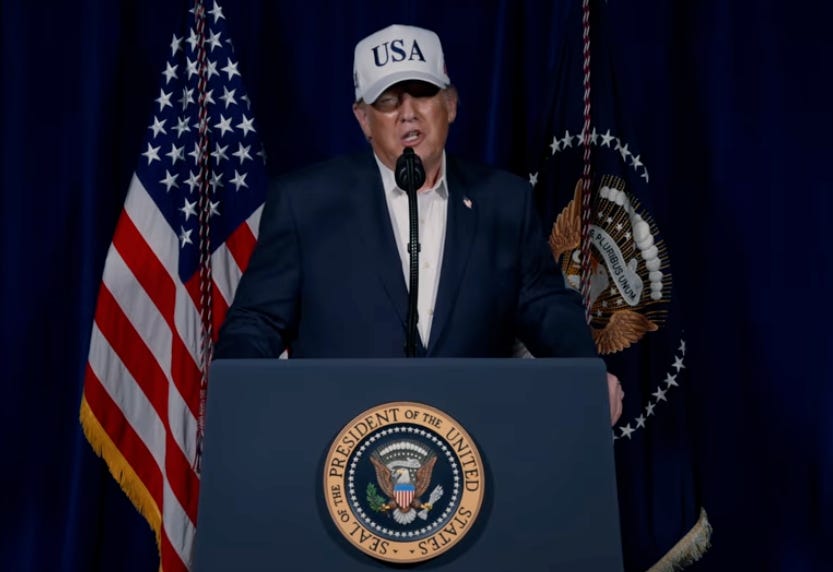
Donald Trump’s attack on Iran is the epitome of his personality-focused approach to foreign policy.
Supreme Leader Ali Khamenei was a notorious dictator who detested the United States, but at age 86, his years were numbered. Other presidents may have longed to topple the Iranian theocracy, but they didn’t target the regime’s leadership because of the potential long-term blowback to American interests, including terrorist attacks on American assets and targeted assassinations around the globe for years to come.
A functioning democracy conducts its foreign policy based on the nation’s interests. That’s because elected representatives, such as a president, should make decisions based on the long-term goals of the country, not the leader’s whims.
As Lord Palmerston, the 19th century British prime minister, once said, “We have no eternal allies, and we have no perpetual enemies. Our interests are eternal and perpetual, and those interests it is our duty to follow.”
French President Charles de Gaulle was even more pithy: “No nation has friends, only interests.”
There’s often a tension between stated foreign policy objectives and long-term national interests. Many U.S. presidents said they supported the aspirations of the pro-democracy groups, and yet backed autocrats such as Egypt’s Hosni Mubarak and the Saudi royal family because they supported U.S. interests in the Middle East. I recall how a Saudi diplomat once told me that he ignored all Saudi-bashing during American election campaigns because “it doesn’t matter once they get their first security briefing as president.”
But, more than any other recent president, Trump views the world through the simplistic lens of his personal friends and enemies. American long-term interests are rarely part of the equation. That’s why he never provides a clear rationale for what he’s doing. Ours is not to reason why; he just expects people support him without question.
For example:
Venezuelan president Nicolás Maduro — who mocked Trump as a “bandit” and a “thief” — was deemed an enemy, so he was seized by U.S. forces and taken to the United States for trial. But Trump apparently has little interest in fostering Venezuelan democrats who won the last election, even though that had been a goal of U.S. foreign policy, so the corrupt Maduro regime was left in place.
Khamenei — who Trump labeled “one of the most evil people in History” — has now been killed, in coordination with Israel, but Trump appears to have given little thought about what happens next. He’s given vague support to regime change, without explaining how the United States will support that, but it’s more likely that the attacks will help entrench regime hardliners who will view Khamenei as a martyr and vow revenge. Trump supporters claim he’s ended a 47-year war with Iran, but in reality, it’s only moving to the next phase.
Russian president Vladimir Putin invaded Ukraine, a sovereign state, and became an international pariah. Yet he’s learned how to flatter Trump, and for some reason Trump adores him. So Trump has upended the U.S.-European alliance and all but halted aid to Ukraine, even though a Russian victory would be a devastating setback to American interests. It doesn’t matter to Trump, because he thinks Putin is his friend — and because Putin has dangled the possibility of “tremendous” deals if the war were settled to Russia’s satisfaction. (I would love to see the KGB file on Trump that taught Putin how to manipulate Trump.)
There are many similar stories. Trump recounts how he boosted tariffs from 30 percent to 39 percent on Switzerland last July because he didn’t like the tone of voice of then-Swiss leader, Karin Keller-Sutter. She “just rubbed me the wrong way, I’ll be honest with you,” he said. He then reduced the tariffs to 15 percent after Swiss business leaders presented him with a Rolex clock and a personalized gold bar worth more than $130,000.
Foreign policy based on personality is not only damaging to the long-term interests of the United States but also deeply corrupting. When policy depends on presidential moods, the country eventually pays the price.
You know, Glenn, if our elected representatives in Washington DC released all of the Epstein files, Putin would no longer have a hold over Trump IMHO.
Ok, I’m not so humble, but I’ve watched that man for 45 years through different media sources, even Access Hollywood!! We know what Putin has on Trump and none of it is legal.