
Why Do Americans Keep Falling for This Scam?
Trump's promises about the border wall, tariffs and now the White House ballroom all follow the same three-stage script.

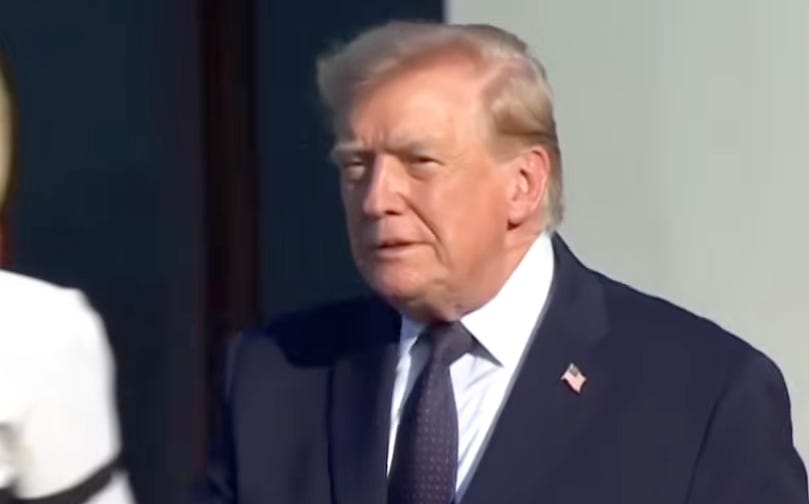
Why do Americans keep falling for this scam?
On March 31, sitting at his desk to sign an executive order on elections, Donald Trump spoke about the new $400 million East Wing ballroom and made a familiar promise. “The taxpayers are not putting up a dime,” he said.
But contractor records reviewed by The Washington Post showed this was a lie. More than half of the ballroom’s rapidly escalating $600 million cost was coming from taxpayers.
Surprise, surprise. Trump’s promise of freebies follows a familiar three-stage arc: an absolute promise, a narrower redefinition once reality surfaces, and a retroactive declaration that the promise was fulfilled on terms it never originally contained.
The ballroom is not an outlier. It is simply the latest example where the script’s first two stages are already visible.
Stage One: The Absolute Promise
The opening move is strikingly consistent: a categorical, quotable pledge, often with a round number and a superlative attached.
On the border wall with Mexico, in Cadillac, Michigan, in March 2016: “I said 100% not, not 99%. I said 100%… they will pay, OK?”
At a rally in Cincinnati in August 2019, on the tariffs: “You’re not paying for those tariffs. China’s paying for those tariffs.”
Aboard Air Force One in March 2026, on the ballroom: “There’s not one dime of government money going into the ballroom.”
Zero, none, not a dime.
Stage Two: The Redefinition
The second stage often appears before the cost dispute has fully surfaced. New categories appear — security, Treasury revenue, reimbursement — that sit just outside whatever the original promise covered.
For instance, on the ballroom on October 23, 2025, White House Press Secretary Karoline Leavitt began adding caveats: “Security enhancements… will be made and maintained by United States Secret Service,” she told reporters. “As for the cost of the ballroom and the construction itself… privately funded.”
Trump’s border wall followed the same pattern. As I noted in my “On Trump’s Bullshit” series, Trump’s pledge that Mexico would pay for the wall was one of his most memorable campaign promises. From his announcement speech to the election, he declared 212 times that Mexico would pay for the wall, according to the comprehensive record of Trump’s speeches, interviews and tweets maintained by Factba.se. That worked out to roughly once every two days.
But the promise quickly ran into reality, as the Trump campaign struggled to explain the payment mechanism. Trump first said he would threaten to cut off the flow of billions of dollars that Mexican immigrants sent home unless Mexico immediately made a “one-time payment” of $5 billion to $10 billion. (His original estimate for the cost of the wall was $8 billion.)
In January 2017, David Muir of ABC News pressed Trump on whether American taxpayers would pay first. “We’ll be reimbursed at a later date,” Trump said. “That wall will cost us nothing.”
The pledge had shifted from direct payment to indirect reimbursement — a category that, by design, could be filled in later with almost anything.
The tariffs offered another variation. Even as Trump kept insisting China was paying, in defiance of basic economics, he began describing tariff revenue as money “pouring into our Treasury.” When farmers needed help offsetting the trade war’s damage in 2019, Trump explained that “this support for farmers will be paid for by the billions of dollars our Treasury takes in.”
China still “paid,” in the telling. But the money was now domestic — extracted from U.S. importers, largely passed on to American consumers, as every economist expected.
In each case, the new categories relocate costs into places the original promise did not name. Once there, the expense becomes harder to test against the line voters remember.
Stage Three: Retroactive Fulfillment
The third stage is the victory lap. The promise gets declared fulfilled on terms that did not exist when it was made.
The Rose Garden, January 4, 2019: with the government shut down over wall funding, Trump told reporters that the renegotiated North American Free Trade Agreement would generate enough economic benefit that “Mexico is paying for the wall… many, many times over.”
Later that year, Trump offered a new payment mechanism — that Mexico had agreed to station 15,000 personnel near the U.S. border and 6,500 near Mexico’s southern border. Campaigning in 2024, Trump claimed that Mexico had “paid much more with what they gave us on the soldiers, on the Remain in Mexico stuff.”
The original promise — a one-time check of $5 to $10 billion — had been retired in favor of vague trade gains and troop deployments. To date, the wall has cost $60 billion. How much did Mexico pay? Nothing.
In the case of the ballroom, Trump’s false claims about the cost have been especially brazen. The Washington Post documented that funding was projected to rely on taxpayer dollars from the moment it was announced. Yet in an April judicial filing appealing a judge’s order to stop construction, Justice Department lawyers repeated claims that taxpayers would pay nothing. The judge had ruled the ballroom needed congressional authorization.
Here are two lines from the appeal:
“Almost 400 Million Dollars of private donations and contributions (No taxpayer dollars are being used to build this long sought, and desperately needed, ballroom!) have already been committed, or spent, in the purchase of heavy, large scale, and other types of building materials.”
“[The] ballroom will have ‘zero cost to the American Taxpayer!’”
Americans have seen this story before. The promise starts as absolute. The explanation becomes conditional. The fulfillment is declared retroactively. The ballroom has already reached Stage Two. Stage Three is usually not far behind.
The mystery is not how the story ends. It’s why so many people keep acting surprised by the ending.
(Note: research into Trump’s rhetoric over the years was assisted by the “Ask Trump” collection of Sourcebase, where I am chief content officer. Readers are invited to get a free account and explore our extensive collections of documents.)
"Americans have seen this story before. The promise starts as absolute. The explanation becomes conditional. The fulfillment is declared retroactively." Sadly, a summary of this entire term in office. Well done Glenn and thanks for the Sourcebase note. I will follow up.
Glenn, while I agree with the premise and content of your story, I think some of those people aren’t really falling for it, as much as they just don’t seem to care.